 Arthur O. March 14, 2026

Meta is rolling out new AI‑powered defenses against online fraud, launching anti‑scam tools across WhatsApp, Facebook and Messenger that are designed to stop criminals before they reach users’ wallets. The company says the changes build on a year in which it removed more than 159 million scam ads and shut down nearly 11 million accounts tied to organized scam networks.
Meta’s New Anti‑Scam Push
In a March announcement, Meta detailed a fresh wave of protections that use artificial intelligence to detect scammers impersonating celebrities, brands and trusted contacts across its platforms. The goal is to surface clear warnings at the moment of risk—when someone gets a suspicious friend request, a sketchy WhatsApp device‑link prompt, or a too‑good‑to‑be‑true message in Messenger.
Meta’s own enforcement data underscores the scale of the problem: in 2025 alone, the company says it removed 159 million scam‑related advertisements and took down about 10.9–11 million accounts linked to criminal scam centers. The new tools aim to prevent those operations from simply reappearing under fresh profiles and domains.
WhatsApp: Cracking Down on Device‑Linking Scams
On WhatsApp, scammers have increasingly abused the legitimate device‑linking feature, tricking people into connecting their account to attacker‑controlled devices via malicious links or QR codes. Once linked, criminals can read messages, impersonate the victim, and pivot to more lucrative fraud such as investment schemes or account‑takeover attempts.
Meta is adding prominent device‑linking warnings that flag suspicious attempts and clearly show where a linking request originates before a user approves it. By adding friction at this step—forcing users to consciously confirm unusual requests—the platform hopes to shut down one of the fastest‑growing attack paths on encrypted messaging.
Facebook: Smarter Warnings on Friend Requests
Facebook is introducing AI‑driven alerts for suspicious friend and follow requests, a common starting point for social‑engineering campaigns. When a request comes from an account with no mutual friends, a mismatch between claimed location and technical signals, or a suspiciously recent creation date, users may now see a warning banner.
These alerts are designed to disrupt the classic scam pipeline in which fake profiles slowly collect mutual connections to look legitimate, then pivot to sending fraudulent messages, investment pitches or phishing links via Messenger. Meta says similar logic also helps surface impersonation attempts that hijack public figures’ names, brands and fan pages.
Messenger: AI Eyes on Scam Patterns
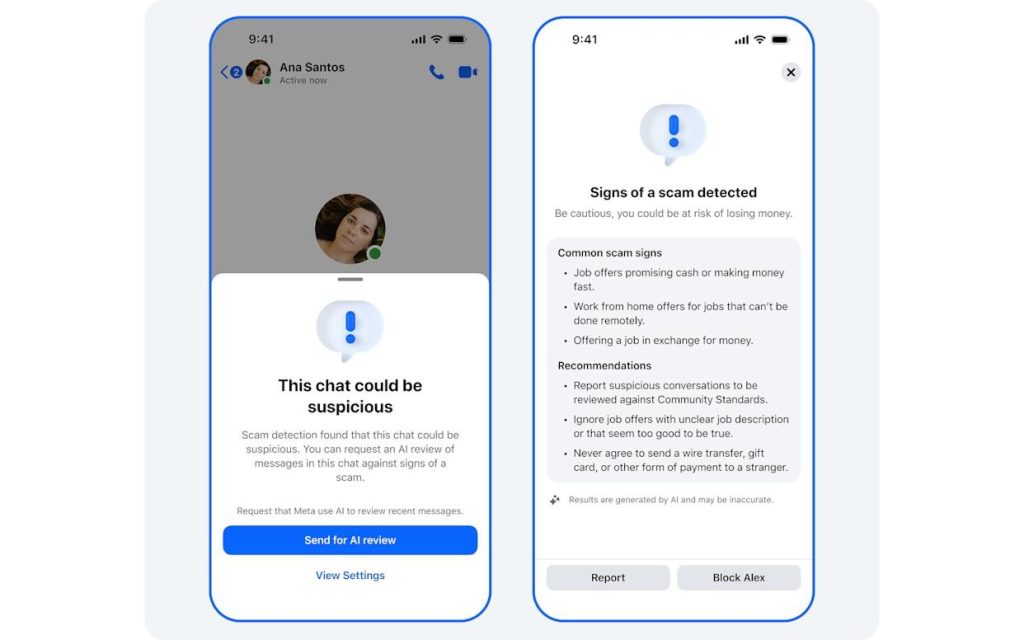
Messenger’s scam detection is expanding to more countries, with AI systems that scan for patterns associated with fake job offers, investment lures, work‑from‑home schemes and other high‑yield frauds. When uncertain contacts send messages that resemble known scam templates, Messenger can notify the recipient and invite them to treat the chat with caution.
Users will also have the option to submit recent messages for AI review, allowing Meta’s systems to analyze text, images and contextual clues to identify celebrity impersonation, brand spoofing and deceptive links before people click. Meta says these on‑device and server‑side checks work together to keep more fraudulent content from ever reaching an inbox.
How the AI Protection Works
Behind the scenes, Meta’s new tools rely on models that evaluate profiles, messages, images, links and behavioral signals for red flags tied to known scam tactics. Signals can include rapid‑fire friend requests, clusters of accounts created from the same infrastructure, or links that redirect to cloned login pages and fake investment portals.
Meta emphasizes that the AI systems look at patterns rather than single messages in isolation, enabling them to spot coordinated scam networks operating across multiple apps and accounts. When those networks are confirmed, the company says it not only removes ads and accounts but also works with law enforcement—a recent operation reportedly led to the arrest of 21 people tied to large‑scale fraud.
What This Means for Everyday Users
For regular users, the biggest change will be seeing more warnings at critical moments: when approving device links on WhatsApp, accepting friend requests on Facebook, or responding to unusual messages in Messenger. These alerts don’t replace basic vigilance, but they provide an extra layer of defense against increasingly polished scams that mimic employers, banks, celebrities and even government agencies.
Security experts note that scammers will adapt, using more convincing profiles and scripts to slip past automated checks, so user education still matters. The safest approach combines platform tools with personal best practices: verify out‑of‑band, distrust pressure tactics, and never move money or share sensitive data based solely on a message or friend request.
Quick Tips to Stay Safer
As you encounter these new protections, a few habits will help you get the most from them:
- Pause when you see a new warning; don’t click through on autopilot.
- Treat friend requests with no mutual contacts or mismatched locations as high‑risk.
- Be wary of job offers, investments or romantic interest that move quickly from public posts to private chats.
- Double‑check any link that leads to a login page or payment request, especially if it comes from a newly created account.
These tools give you more signals, but your skepticism is still the most reliable firewall.
