 Arthur O. October 21, 2026


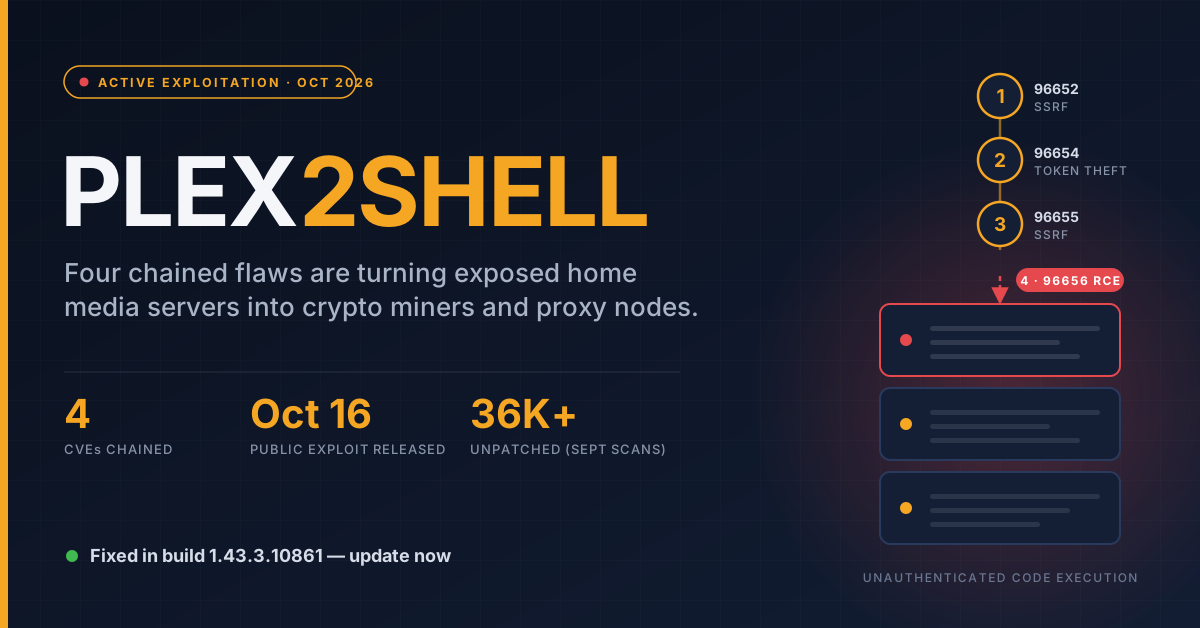
Attackers began exploiting unpatched Plex Media Servers within a day of a public proof-of-concept. The fix had been available for weeks. The open question is how many servers are still exposed.
4
CVEs chained into unauthenticated code execution
~1 day
From public exploit (Oct 16) to first observed attack (Oct 17)
36,000+
Unpatched servers exposed online (Shadowserver, early Sept)
10861
Minimum safe build: 1.43.3.10861
On October 16, a security researcher published a full write-up and working proof-of-concept for a chain of four vulnerabilities in Plex Media Server. By the next day, someone was using it. A researcher running an internet-facing Plex honeypot recorded the first in-the-wild compromise on October 17: attackers dropped a cryptocurrency miner and, later that day, a proxy program that lets strangers route their traffic through the victim’s connection. On October 19, Plex itself confirmed that the chain is being exploited widely.
The uncomfortable part is the calendar. The fix had been available for more than six weeks by the time the exploit went public. Plex’s forum shows build 1.43.3.10861 posted on August 3, and on September 1 Plex published an advisory urging every server owner to update, then took the uncommon step of emailing customers. It named no CVEs and gave no technical detail. Days later, the Shadowserver Foundation counted more than 36,000 internet-exposed servers still running vulnerable software. Those are the machines now being swept.
Two caveats up front. The public indicators of compromise come largely from a single honeypot that was deliberately running an outdated version, and no reliable count of confirmed victims has been published. Outlets also disagree on several details, which are collected in the section on where the reporting diverges. Everything below is attributed so you can check it.
⚠ If you run Plex, do this today
- Update to Plex Media Server 1.43.3.10861 or later. Plex says the version shows under Settings → General in Plex Web. Confirm the build number rather than trusting an update notification.
- If your server was older than that and reachable from the internet, treat it as potentially compromised. That is Plex’s own guidance. The checks and rebuild steps are below.
- If you do not need remote access, turn it off (Settings → Remote Access) and avoid forwarding port 32400 directly to the internet.
Timeline: From Private Report to Mass Exploitation
The chain was reported through a normal disclosure process. Researcher Zach Main reported it to Plex on July 27, Plex acknowledged it and paid a bounty on August 4, and the researcher published his write-up on October 16 (Main’s account, SecurityWeek, BetaNews). The gap that mattered was between the patch and the patching.
| Date (2026) | Event | Reported by |
|---|---|---|
| Jul 27 | Researcher Zach Main reports the vulnerability chain to Plex. | zmain.info; SecurityWeek |
| Aug 3 | Build 1.43.3.10861 is posted to Plex’s forum release thread, labelled as a Beta (Plex Pass) release. Its notes mention two security fixes: one in the CompanionProxy and one preventing the transcoder H.264 option preferences from being changed over the network. | Plex forum release thread |
| Aug 4 | Plex acknowledges the report and pays a bounty. | zmain.info; SecurityWeek; BetaNews |
| Aug 13 | Plex Desktop 1.115.0 released with related fixes. | BleepingComputer |
| Sep 1 | Plex advisory urges all server owners to update from 1.43.2 or earlier. No CVEs, no technical detail; Plex says CVE records have been requested. Customers are also emailed. | Plex forum; BleepingComputer |
| Sep 4–9 | Shadowserver begins daily scans for unpatched servers and reports more than 36,000 exposed instances. | BleepingComputer |
| Sep 23 | CVE records are assigned and published to the National Vulnerability Database. | zmain.info; SentinelOne vulnerability database |
| Oct 16 | Write-up and working proof-of-concept published. | SecurityWeek |
| Oct 17 | First in-the-wild exploitation recorded on an internet-facing honeypot. | boredhackerblog, via SecurityWeek and The Hacker News |
| Oct 19 | Plex updates its advisory with the four CVEs and confirms active, widespread exploitation. | Plex forum; BetaNews |
“These vulnerabilities are being actively and widely exploited.”
Plex security advisory update, October 19, 2026
Anatomy of Plex2Shell
Plex2Shell is the name given to a chain, not a single bug. Each stage is a modest flaw on its own. Combined, they let an unauthenticated remote attacker run code with the privileges of the Plex Media Server process (Plex; SecurityWeek). In plain terms, the chain forges a request the server then trusts, uses that to reach internal functions that were meant to be local-only, extracts the owner’s admin token, and finally abuses the transcoder’s settings to write an attacker-controlled file into a folder the server later loads as code.
The Plex2Shell Chain
Four stages from the open internet to code execution
1
Forge a request
An unauthenticated flaw in the player timeline endpoint makes the server send a request to a destination the attacker chooses.
2
Reach internal functions
The forged request is routed to internal plugin and agent functions meant to be reachable only locally, with attacker-supplied parameters.
3
Take the admin token
The owner’s admin token is exposed, which gives the attacker owner-level access to the server’s own transcoding functions.
4
Plant and run code
Transcoder settings are abused to write a file into the Codecs directory, which the server then loads. Code runs as the Plex service account.
Stage descriptions follow the researcher’s and Plex’s accounts. Which CVE maps to which stage differs between sources; see the table below.
Plex’s own summary of the four CVEs, published October 19, and the descriptions in The Hacker News and the NVD-derived vulnerability databases line up on the four stages but label the individual CVEs differently. Both are shown so you can cite whichever source you are working from. The CVSS scores are as reported by The Hacker News.
| CVE | CVSS | Plex’s description (Oct 19) | Description in The Hacker News / NVD-derived records |
|---|---|---|---|
| CVE-2026-96652 | 5.3 | Unauthenticated server-side request forgery (SSRF) in the player timeline endpoint | SSRF via /player/timeline. An unvalidated protocol parameter lets an attacker force the server to POST to a destination of their choice. NVD-derived entries say any token value is accepted, so no valid credential is needed. |
| CVE-2026-96654 | 6.9 | Access to internal agent functions over the loopback interface | Improper neutralization of URL values in the searchOne endpoint, letting an attacker call other plugins’ functions with their own parameters and obtain the owner’s admin token. |
| CVE-2026-96655 | 5.3 | Disclosure of the server owner’s admin token | SSRF in the universal transcode endpoint (/video/:/transcode/universal), usable with the owner token, for example to fetch an attacker-hosted payload. |
| CVE-2026-96656 | 8.6 | Arbitrary file write to the Codecs directory through transcoder preferences | External control of file name or path. Writes an ELF shared object to an attacker-chosen path in the Codecs directory, which is then executed. |
A fifth flaw, CVE-2026-96651 (CVSS 7.1), was disclosed alongside the four. According to SentinelOne’s vulnerability database it is a path traversal in the /system/agents/media/get endpoint that can expose the PlexOnlineToken, and it is also reachable from the local network. The Hacker News does not list it as part of the chain, and neither does Plex’s October 19 post. It is fixed in the same build.
Analysis: why a chain of “medium” bugs matters
Three of the four flaws score between 5.3 and 6.9. CVSS rates each flaw in isolation, so a queue ranked by score would have placed most of this chain in the middle of the pile. The combined outcome is unauthenticated remote code execution. Triage that looks only at individual scores understates the risk of bugs that are designed to be chained.
The disclosure sequence compounded it. Plex’s September 1 advisory carried no CVE identifiers, and Shadowserver noted that the absence of identifiers makes risks harder for the wider community to track and prioritise (as summarised by ThaiCERT from BleepingComputer’s reporting). Scanners and patch-management tools key off CVE records. The records did not exist until September 23.
What the Attackers Deployed
According to The Hacker News, the observed attacks use a shell script that pulls a payload with wget or curl from a remote server and runs it. Two things have been seen running on compromised hosts: an XMRig cryptocurrency miner and a proxy program.
| Indicator | What it is | Source |
|---|---|---|
mylovelyminer | XMRig miner process, with its mining server pointed at ota.proxystream[.]st. A related subdomain, global.relay.proxystream[.]st, was flagged by Bitsight in August 2026 in connection with the AISURU DDoS and proxyware botnet. That is an infrastructure overlap, not an attribution. | The Hacker News |
x12345 | Miner payload fetched by the attack script from 217.60.194[.]116. | The Hacker News |
myawesomeproxy | Described by VirusTotal as a stealthy Linux backdoor and reverse proxy. It prints a notice that running it means agreeing to external use of your internet traffic. | The Hacker News; SecurityWeek |
| Attack source IPs | 91.92.40[.]202, 176.65.139[.]228, 45.194.92[.]222 | The Hacker News |
| Behavioural signs | Unfamiliar processes spawned by the Plex Media Server binary; unfamiliar .so or .dll files in the Codecs folder; outbound connections to proxystream.st; sustained high CPU use while nothing is playing; command-line arguments referencing rig identifiers or donate levels. | Plex; CordCuttersNews |
The miner is the loud part of this campaign. It burns processor time and tends to get noticed. The proxy is the quiet part, and probably the more valuable one. A residential proxy lets someone else browse and connect from the victim’s home IP address, which carries far better reputation than a data-centre address. The researcher who caught the attacks on a honeypot said as much, noting that a residential address would be attractive to anyone wanting to reach corporate VPNs and email without tripping location checks (via SecurityWeek). A media server in a home office can sit on the same network as work devices.
⚠ Limits of the evidence
The researcher who published the indicators cautioned that they cover only what the honeypot saw (via SecurityWeek). Other campaigns may use different payloads. Reddit posts describe real users compromised with the same “mylovelyminer” payload, but The Hacker News notes it is not yet known whether those cases stem from Plex2Shell. Absence of these indicators is not proof that a server is clean.
Why Plex Keeps Landing Here
Plex Media Server is self-hosted software that millions of people deliberately expose to the internet so family and friends can stream from it. That makes it a standing target, and its history shows a pattern.
- CVE-2020-5741. A remote code execution flaw that CISA flagged as actively exploited in March 2023 (BleepingComputer). BetaNews links it to the 2022 LastPass breach, where an attacker reached a DevOps engineer’s home machine through a vulnerable media server.
- CVE-2025-34158. A high-severity flaw patched in August 2025 that allowed theft of the server owner’s credentials (BleepingComputer).
- Plex account database breaches. Plex forced password resets after unauthorised access to a customer database in August 2022, and again in September 2025, when emails, usernames, hashed passwords and authentication data were accessed (TechCrunch; SecurityWeek). Plex asked users to reset passwords and sign out connected devices.
The recurring theme is the owner’s token. The 2025 flaw stole credentials, one of this year’s CVEs exposes the PlexOnlineToken, and the Plex2Shell chain works by extracting the admin token on the way to code execution. Whoever holds that token holds the server. This is why the account-level steps below matter as much as the patch.
Are You Affected? A Triage Table
| Your situation | Assessment | What to do |
|---|---|---|
| Patched to 1.43.3.10861 or later before Oct 16 | None of the reporting reviewed describes exploitation before the public release on Oct 16. Absence of reports is not proof. | Confirm the build number, enable two-factor authentication on your Plex account, and review whether the server needs to be internet-facing. |
| Updated on or after Oct 16, server was internet-reachable | You may have been exposed while scanning and exploitation were under way. | Run the compromise checks below. If anything looks wrong, or you cannot rule it out, rebuild. |
| Still older than 1.43.3.10861 and reachable from the internet | Plex says to assume possible compromise. | Disable remote access, update, check for indicators, rebuild from a clean install, change your Plex password and sign out all devices. |
| Older build, reachable only on your local network | The chain needs network access to the web interface. Lower risk, not zero: other devices on the LAN or a guest network could reach it. | Update promptly and restrict who can reach port 32400. |
How to Check for Compromise
Plex’s guidance is to check the version, look for the indicators above, and, if a compromise is found or cannot be ruled out, rebuild. The commands below are a Linux starting point for the same checks. Paths and package names differ on Docker, NAS, Windows and macOS installs, so adjust accordingly. They only look for what has been publicly reported.
# Installed version (Debian/Ubuntu)
dpkg -s plexmediaserver | grep -i '^Version'
# Installed version (Fedora/CentOS)
rpm -q plexmediaserver

# Process names and strings from the public reporting
ps -eo pid,ppid,user,etime,cmd | grep -Ei 'myawesomeproxy|mylovelyminer|x12345|proxystream' | grep -v grep

# Network connections owned by the Plex process
ss -tnp | grep -i plex

# Files changed recently in the Codecs folder (default Linux path)
find "/var/lib/plexmediaserver/Library/Application Support/Plex Media Server/Codecs" -type f -mtime -30 -ls

# Transcoder options you did not set yourself (per Plex's guidance)
grep -i 'TranscoderH264Options' "/var/lib/plexmediaserver/Library/Application Support/Plex Media Server/Preferences.xml"
Two practical notes. First, the Codecs folder normally holds codec files that Plex downloads itself, so triage by timestamp and provenance rather than by file type alone. Second, check your DNS and firewall logs for lookups of proxystream.st from the Plex host. A miner or proxy that has been renamed will still need to call out.
How to Stay Safe
Items 1, 2 and 3 follow Plex’s own advisories. The rest are standard hardening for any self-hosted service, offered here as recommendations rather than Plex guidance.
- Update, then verify the build. Windows and macOS: enable automatic updates or download from Plex’s site. Linux: download the
.debor.rpmpackage and install it withdpkgordnf. NAS: the package centre may lag, so install the vendor-appropriate package manually following the guides Plex links for QNAP, Terramaster, Western Digital, Netgear and Synology. Docker: follow the pms-docker README. NVIDIA Shield: install pending updates from Google Play. Then confirm 1.43.3.10861 or later under Settings → General in Plex Web. - Take the server off the open internet if you can. If you do not need remote access, switch it off under Settings → Remote Access and do not forward port 32400. If you do need to stream away from home, consider placing the server behind a VPN or overlay network so the web interface is never publicly reachable.
- Protect the Plex account like an admin credential. Use a unique password and enable two-factor authentication, which Plex itself recommended after the 2025 account breach. If you reset the password, use the option to sign out connected devices.
- Run Plex with least privilege. Use a dedicated unprivileged account or a container, mount media libraries read-only where possible, and keep no credentials, SSH keys or password files on the same host. The exploit runs as the Plex service account, so what that account can reach defines the damage.
- Segment it from everything that matters. Put the server on its own VLAN or at least off the network used by work laptops and phones. A compromised proxy node on the same network as a work device is a stepping stone.
- Restrict outbound traffic. Miners and proxy clients have to call out. Allowing the Plex host to reach only the destinations it legitimately needs breaks both payloads, and SentinelOne’s records recommend egress restrictions for this reason.
- Watch for the quiet failures. Alert on sustained CPU use while nothing is streaming, on new child processes of the Plex binary, and on unexpected outbound connections. Forward logs somewhere the server cannot overwrite.
- If you truly cannot patch today, buy time, not safety. Block port 32400 at the perimeter until you can update. SentinelOne’s records also suggest a reverse proxy that validates or strips the
protocolparameter on/player/timeline. Treat that as a stopgap for one stage of the chain, not a substitute for the patch.
✓ If you find signs of compromise, or cannot rule it out
- Rebuild from a clean installation rather than reusing the old data directory. Plex says that, at a minimum, you should delete everything in the Codecs folder and review
Preferences.xmlfor transcoder options you did not set. - Sign out of all devices and change your Plex password. If you reused that password anywhere else, change it there too.
- Treat everything the Plex service account could reach as exposed, including mounted network shares and credentials stored on the same machine or VM. Rotate those credentials.
For Security Teams
Plex is consumer software, but it routinely runs on the networks of people who also work from home. A few practical points:
- Hunt for the published indicators in DNS, proxy and egress logs:
proxystream.stand its subdomains, the payload host and the attack source addresses listed above. Remember they derive from one honeypot. - Scan your own ranges for exposed Plex. Network owners can get free scan reports from the Shadowserver Foundation, which has been tracking unpatched Plex servers since early September.
- Treat residential-proxy exposure as a credential-access risk, not just a nuisance. An attacker routing traffic through an employee’s home address can make logins to corporate VPNs and email look local. Review conditional-access rules that lean heavily on IP reputation and geography, and favour phishing-resistant authentication.
- Include home-lab and self-hosted services in remote-worker guidance. A short policy line, “do not expose self-hosted services directly to the internet from a network that also carries work devices,” costs nothing.
Where the Reporting Disagrees
- When the fix shipped. Plex’s forum release thread dates build 1.43.3.10861 to August 3 and marks it as a Beta release for Plex Pass users. BleepingComputer’s September reporting says 1.43.3 was released on May 19, a date that predates the July 27 disclosure and that could not be reconciled with the other sources. The build number is what matters; confirm it directly.
- Which CVE is which. Plex’s October 19 summary and the descriptions in The Hacker News and NVD-derived databases map the four CVEs to the chain’s stages differently, as the table above shows.
- How many servers are exposed. The 36,000-plus figure is Shadowserver’s count of unpatched, internet-exposed servers from early September. Cybernews, citing Shadowserver’s public data, reported nearly 300,000 Plex instances exposed in total (about 134,800 in the US), which includes patched ones. No post-exploit count was found.
- Whether the Reddit reports are Plex2Shell. Users report compromise by the same miner payload, but the link to this chain is unconfirmed (The Hacker News).
- What was not independently reviewed. The researcher’s honeypot post, Bitsight’s AISURU analysis and the proof-of-concept repository are linked in the reporting above but were not separately reviewed for this article.
The Road Ahead
The sequence here is becoming familiar. A researcher discloses privately, the vendor ships a quiet fix, a short advisory goes out with no detail, a large pool of exposed servers stays unpatched, and a public proof-of-concept turns the gap into an attack window measured in hours. Plex has not said why CVE records took until September 23 to appear, or why the full description waited until October 19. What is visible from outside is the cost: for most of September, defenders had a warning and no identifier to track.
For individual owners, the lessons are unglamorous. Turn on automatic updates, keep the admin surface off the public internet, and treat the Plex token as the credential it is. For everyone else, this is a reminder that “it’s only a media server” stopped being true when attackers learned that a home IP address is worth more than a few seconds of CPU time.
Sources
- Plex, “Important Security Update for Plex Media Server v1.43.2 and earlier” (Sept 1 and Oct 19, 2026 posts): forums.plex.tv
- Plex Media Server 1.43.3.10861 release thread (Aug 3, 2026): forums.plex.tv
- Zach Main, “Plex2Shell” write-up and disclosure timeline: zmain.info
- The Hacker News, “Hackers Exploit Plex2Shell Flaws to Install Crypto Miners and Linux Proxy Backdoor,” Oct 19, 2026: thehackernews.com
- SecurityWeek, “Plex2Shell Exploit Chain Weaponized Against Plex Servers Hours After Disclosure,” Oct 19, 2026: securityweek.com
- BetaNews, “Plex confirms active exploitation of unpatched media servers and publishes four CVEs,” Oct 20, 2026: betanews.com
- CordCuttersNews, Plex Media Server update warning, Oct 18, 2026: cordcuttersnews.com
- BleepingComputer, “Over 36,000 exposed Plex servers vulnerable to recent flaws,” Sept 9, 2026: bleepingcomputer.com
- BleepingComputer, “Plex warns users to patch security vulnerabilities immediately,” Sept 3, 2026: bleepingcomputer.com
- Cybernews, Plex patch warning and exposure counts, Sept 2026: cybernews.com
- SentinelOne vulnerability database entries for CVE-2026-96651 through CVE-2026-96656: sentinelone.com
- TechCrunch, “Plex urges users to change passwords after data breach,” Sept 9, 2025: techcrunch.com
- SecurityWeek, “Plex Urges Password Resets Following Data Breach”: securityweek.com
- Referenced in the reporting above: boredhackerblog honeypot post (link); Bitsight, “Who invited AISURU to the LAN party” (link)
