 Arthur O. October 25, 2026


It is the most-repeated story in IoT security: an internet-connected aquarium thermostat becomes the foothold into a casino’s network. What do we actually know about it, and what does it still teach?
2017
Year the story first surfaced (Darktrace, via CNN)
0
Public names for the casino or the device
1 source
Every account traces back to Darktrace
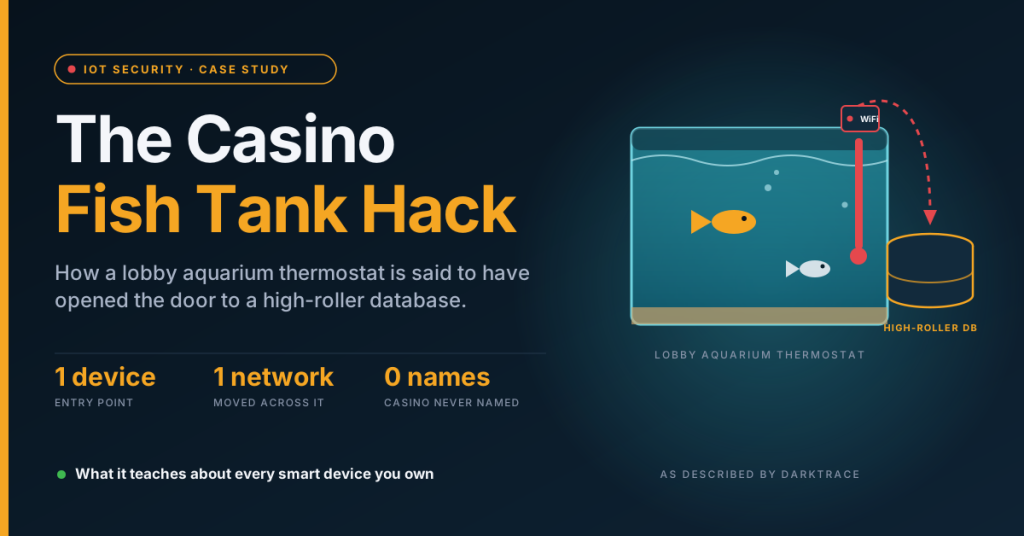
A fish tank sits in the lobby of a North American casino. It has a smart thermostat that keeps the water at the right temperature and reports back over the network. Someone on the internet finds a way in through it, crosses into the part of the network that matters, and takes a database of the casino’s biggest-spending customers. Then the data leaves through the same little device.
That is the story as it has been told at conferences and in headlines since 2017, and it has become shorthand for everything wrong with connected gadgets. It is worth retelling carefully, because the true part is more useful than the legend. The facts are thinner than the retelling suggests: the casino has never been named, the device has never been identified, and every public account leads back to one security company.
The incident comes from the security firm Darktrace, which says its own technology detected it. The victim, the date of the breach and the exact device have never been publicly confirmed by anyone else. We present it as a widely reported, single-source case study. The lessons it points to do not depend on this one incident being exactly as described, because the same pattern has been documented elsewhere.
What Was Reported, and By Whom
The story arrived in two stages, from two Darktrace voices.
| When | Who | What was said |
|---|---|---|
| July 2017 | Darktrace threat report; Justin Fier, Darktrace’s director of cyber intelligence, to CNN (CNN story dated July 19) | A “North America based casino” was breached through an internet-connected fish tank. The attackers “scanned, found other vulnerabilities and moved laterally to other places in the network,” and data was sent out to a device in Finland. The attack was identified and stopped (per Hackread’s summary of the report). |
| July 2017 | Dave Palmer, Darktrace co-founder | “We’ve seen insiders sneak data out of heavily-protected organizations by attacking digitally-connected fish tanks.” TNW notes this may refer to the casino or to a separate case, one involving a fish tank in a payment company’s reception area. |
| April 2018 | Nicole Eagan, Darktrace CEO, at the WSJ CEO Council in London, reported by Business Insider | Attackers used the lobby fish-tank thermostat “to get a foothold in the network,” found the high-roller database, and “pulled that back across the network, out the thermostat, and up to the cloud.” |
“There’s just a lot of IoT. It expands the attack surface and most of this isn’t covered by traditional defences.”
Nicole Eagan, CEO of Darktrace, April 2018 (as reported by Business Insider)
Where the Accounts Disagree
The details shift between tellings, which is typical of a story that has passed through many hands. Readers who cite this case should be aware of the inconsistencies.
| Detail | Variation across sources |
|---|---|
| The device | Called a thermometer, a thermostat, an “aquarium controller” and simply a “fish tank.” ReefBuilders quotes the Darktrace report describing a controller “with advanced sensors that automatically regulate temperature, salinity, and feeding schedules” and names no brand. |
| How much data | ReefBuilders says up to 10 gigabytes. The other accounts reviewed (TNW, Hackread, Gearbrain, Interesting Engineering) give no volume at all, so the figure is not corroborated here. |
| Where it went | 2017 coverage says a device in Finland. The 2018 retelling says “up to the cloud.” These are not necessarily in conflict, but they are not the same description either. |
| What was taken | Hackread’s summary of the 2017 report says only “data”. The 2018 account specifies a high-roller database, described by one outlet as a database of big-spending gamblers’ contacts. |
| Damage and outcome | ReefBuilders notes the damage was not reported. Hackread says the attack was identified and stopped, with no timeline. No financial loss, regulatory action or number of affected customers has been published. |
| The casino | Never named. Described only as being in North America. |
The Attack Path, Step by Step
Darktrace has not published a technical teardown, so the exact exploit is unknown. What the accounts do describe is a classic sequence, shown below. The two stages that matter most to defenders, the first hop and the way out, are highlighted.
From the Lobby to the Database
As described by Darktrace
1
Foothold
An internet-connected thermostat or controller on the lobby aquarium gives attackers a way into the network.
2
Scan and move
The attackers “scanned, found other vulnerabilities and moved laterally” through the casino network (Fier).
3
Find the prize
The high-roller database is located and gathered up (Eagan).
4
Exfiltrate
The data leaves “out the thermostat, and up to the cloud,” or to a device in Finland, depending on the telling.
One detail stands out as a defensive signal. According to ReefBuilders’ reading of the Darktrace report, Darktrace noticed the controller sending out far more data than a device of that kind should. That is a behavioural clue, not a signature. No antivirus would have flagged a thermostat. A system that knew what normal looked like for each device could see this one acting out of character.
Why a Thermostat Is a Good Way In
The real lesson is less about fish than about how organisations treat small connected devices. Four things make them attractive to attackers, none of which is exotic.
- They are forgotten. Nobody owns the aquarium controller. It is not in a patching schedule, an asset register or a security review, because it is not “IT.” Facilities or a contractor installed it and may be the only party that logs in.
- They often cannot defend themselves. Cheap embedded devices frequently ship with default credentials, rarely get firmware updates, and cannot run security software. Researchers at the Weizmann Institute found that many off-the-shelf home devices could be accessed remotely using default factory passwords (as cited in the Interesting Engineering report).
- They are trusted by the network. If the thermostat sits on the same flat network as the databases, a single compromised device is a position inside the perimeter. Firewalls built to keep outsiders out are not designed for a threat that is already inside.
- They have a way out. A device built to phone home to a vendor’s cloud already has outbound connectivity, and many networks do not inspect what flows over it. That is exactly the channel the story describes.
the question that matters
Whether this particular casino was breached exactly this way is the less important question. The better one is: if a device like this were compromised on your network, what could it reach, and who would notice it talking to something unusual? In the story as told, the casino had security measures in place, though this has not been independently verified. The failure was one of architecture and visibility, not of effort.
Former GCHQ head Robert Hannigan made the same point in 2018, citing a bank said to have been hacked through its CCTV cameras. He argued for minimum security standards for connected devices, observing that “the problem is these devices still work. The fish tank or the CCTV camera still work” (as reported by Interesting Engineering). A compromised device keeps doing its job, so nobody has a reason to look at it.
How to Stay Safe
These are standard IoT and network hygiene measures. They are our recommendations, not findings from the Darktrace report, and they apply whether you run a casino, a small office or a smart home.
If you run a business
- Find everything that is connected. Build an inventory that includes the non-IT devices: thermostats, aquarium and HVAC controllers, cameras, badge readers, printers, smart TVs. You cannot protect what nobody knows exists.
- Segment aggressively. Put IoT and building systems on their own network or VLAN, with firewall rules that let them reach only the specific services they need, and nothing that touches customer or payment data.
- Control outbound traffic. A thermostat should talk to its vendor’s service and little else. Allow-list those destinations and alert on anything new. In the reported incident, outbound data was the tell.
- Change defaults and apply updates. Replace factory credentials on day one, disable remote-management features you do not use, and ask vendors how and whether they ship security patches before buying.
- Monitor behaviour, not just signatures. Devices with a narrow job have a predictable pattern. Tools that learn what normal looks like for each one can flag a thermostat that suddenly moves gigabytes.
- Put someone in charge. Make a named owner responsible for each class of device, including those installed by contractors, and include them in vendor and third-party risk reviews.
✓ If you are at home
- Use a guest or IoT network for smart plugs, cameras, thermostats and the like, separate from the one your laptop and phone use. Most modern routers offer one.
- Change the default password on every connected device, and register it with the vendor so you receive update notices.
- Ask whether it needs the internet at all. If a gadget works fine without remote access, switch remote access off.
- Retire unsupported devices. If the maker no longer issues updates, replace it.
Not an Isolated Case
Even if you set the casino story aside as unverified, the pattern it describes is well documented. Darktrace’s Dave Palmer described a second fish tank, in the reception area of a payment company, where an attacker was said to have stored data in the tank’s internal memory and used its connection to move it out of the building (as relayed by TNW). Hannigan’s CCTV-cameras-and-a-bank example makes the same point from another direction.
Larger, better-documented incidents tell the same story at scale. Attackers entering a retailer’s network through a third-party heating and cooling contractor, and botnets assembled from default-password cameras and routers, both rest on the same idea: a device nobody was watching, with more network access than it needed. Ask which gadgets on your network fit that description today.
The Bottom Line
The fish tank hack endures because it is vivid, but its value is in what it makes obvious. Attackers rarely need to defeat your best defences. They need one weakly guarded device that is already trusted. The casino story may be told with a thermostat in the starring role, but the same chain of events could begin with a camera, a printer or a smart lightbulb. Treat the small, boring, connected things as part of your attack surface, and give them the same scrutiny as the servers.
Sources
- Hackread, “Casino Becomes Victim of Data Hack—courtesy Fish Tank,” July 24, 2017 (summarising Darktrace’s report and Justin Fier’s comments to CNN): hackread.com
- The Next Web, “Go phish: smart fish tank let hackers into casino,” July 20, 2017: thenextweb.com
- ReefBuilders, “Aquarium controller used to hack casino,” Aug 7, 2017: reefbuilders.com
- Interesting Engineering, “A casino’s database was hacked through a smart fish tank thermometer,” Apr 16, 2018 (Nicole Eagan at the WSJ CEO Council, via Business Insider): interestingengineering.com
- Gearbrain, “How a thermostat in the lobby fish tank let hackers steal a casino’s high-roller database”: gearbrain.com
- Daily Dot report on the same account (archived by the Cato Institute): clips.cato.org
